Some words earn a place in everyday language because they are easy to say and easy to remember. Names like Reese’s Pieces or Fitbit move quickly from being “a product” to being a familiar reference. You do not have to pause to explain them. They live comfortably in conversation. Over time, familiarity becomes association, and association turns the name into shorthand for something specific and understood. Fix-on-Six follows that same path.
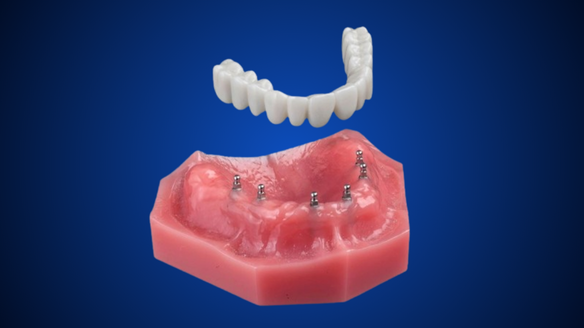
The name Fix-on-Six is straightforward and rhythmic, which makes it easy to recall and easy to repeat. It refers to a full-arch implant denture system supported by mini dental implants. As the term is used and repeated, Fix-on-Six begins to function less like a product name and more like a category. It becomes a shared reference for security, stability, and teeth that stay in place. In that way, the name works not because it is clever, but because it becomes part of the language people use to describe a reliable solution.
What Is Fix-on-Six?
The word “fix” refers to how the restoration functions once it is placed. The prosthetic is secured in position rather than removable, which changes how it behaves throughout the day. It does not rely on suction, adhesives, or movement for stability. Once placed, it remains in position, and only we take it out when maintenance or care requires it.
The second half of the phrase, six, refers to the approximate number of mini dental implants used to support a full arch. While the exact number can vary by treatment plan, six implants often provide the balance of support and distribution needed for a complete upper or lower restoration. Together, the implants support the prosthetic and help distribute bite pressure evenly throughout the jaw.
What Is a Roundhouse Bridge?
At the center of Fix-on-Six is a roundhouse bridge. This is not a traditional bridge in the single-tooth sense. Instead, it is a full-arch dental restoration that replaces an entire row of teeth at once. The restoration follows the natural curve of the jaw in a horseshoe or semi-circular form, allowing it to span the full arch from one side to the other as a single continuous structure.
For many people, it helps to think of Fix-on-Six as a familiar idea refined. It replaces a full arch of teeth, similar to a denture, but without many of the components people would rather live without. There is no daily removal, no reliance on movement, and no need to adapt around something that feels temporary. The result is a fixed, full-arch solution built for stability and day-to-day ease.
How Is Fix-on-Six Different From All-on-4?
All-on-4 follows a similar naming logic to Fix-on-Six. The number signals the approximate number of implants supporting the restoration. In this case, a full-arch fixed bridge is supported by four traditional dental implants placed in the jawbone. These implants are roughly 5 millimeters in diameter
Two implants are typically positioned toward the front of the jaw in a straight orientation, while two are placed farther back at an angle to engage denser bone. The angled placement helps maximize available bone, particularly in areas where bone volume may be limited. For some people, this approach offers a practical and proven path to a fixed full-arch restoration.
However, a fixed bridge supported by four implants relies on fewer anchoring points to absorb daily chewing pressure. That pressure concentrates on each implant, especially in areas that experience higher bite forces. If bone density varies or one implant becomes compromised, the remaining implants must absorb more force, which reduces the system’s ability to compensate over time.
Mini dental implants measure around 3 millimeters in diameter, allowing us to place more of them along the natural curve of the jaw. Using six to ten mini implants creates multiple contact points along the arch, helping to spread chewing forces evenly rather than concentrating pressure in just a few areas. That broader distribution reduces stress on each implant and supports steady function over time.
Because mini implants require less bone volume, they often work well in jaws with lower bone density and frequently allow treatment to move forward without bone grafting.
Discover a Full-Arch Tooth Replacement That Works for You
A fixed full-arch solution works best when stability, bone support, and bite forces align. Taking time to understand those factors can clarify which implant design makes the most sense for you. That understanding helps move the decision beyond labels and toward a solution built for long-term function and day-to-day reliability.
If you are exploring full-arch options and want to understand how different implant systems compare, contact us today to book a free implant consultation.