Full dentures remain one of the most recognized solutions for replacing a large number of missing teeth, especially when an entire upper or lower arch needs to be restored. For many people, the idea of dentures feels familiar. You picture a bulky set of teeth floating in a glass of water, and it seems like the only path forward.
However, full dentures don’t come in just one form. Treatment can range from a conventional denture that rests on the gums to options that use dental implants for better stability and long-term support. Understanding those differences gives you a clearer picture of how each option functions and what it offers. The type of denture you choose affects how it feels day to day, how well it maintains its fit over time, and how it supports your jaw.
Understanding Full Dentures
Tooth loss can result from trauma, gum disease, decay, or other conditions that affect multiple teeth at once. When that happens, we customize dentures to fit your mouth and help restore your ability to eat, speak, and move through daily life with more ease. Full dentures replace all teeth in an upper or lower arch when they are missing or no longer function reliably.
In some situations, the need for full dentures is not tied to complete tooth loss. You may still have natural teeth present, but they may no longer provide the support needed for long-term function. Teeth that are weakened, decayed, or loose can limit the performance of a partial denture.
When those teeth cannot be predictably maintained, removing them creates a more stable foundation for treatment. From there, we can move forward with a full denture that fits more securely.
What Are the Benefits of Full Dentures?
When you no longer have a full set of teeth, everyday tasks start to feel slightly off. Chewing becomes less efficient, speech can feel inconsistent, and you may begin adjusting without fully realizing it.
Over time, changes in your jaw and gums continue after tooth loss. As the underlying bone shrinks and the gums adjust, a denture’s fit can begin to change. Those changes in your jaw and gums affect both the fit of your dentures and the support for your facial structure.
Full dentures restore that missing structure, giving those movements a more reliable rhythm. Eating and speaking no longer require the same level of effort or awareness, which changes how you move through your day.
The Problems With Full Traditional Dentures
While full dentures restore the visible part of your smile, they do not replace the roots that once supported your teeth. Without those roots, the jawbone no longer receives the stimulation it needs to maintain its shape.
Natural tooth roots stimulate the jawbone with every bite and chew. Once those roots are gone, that stimulation stops. As a result, the bone begins to shrink. The gums follow as the shape of your mouth gradually changes. Over time, those changes in your jaw and gums affect the fit of your dentures and the support for your facial structure.
With a traditional denture that rests on the gums, those changes become more noticeable over time. A denture that once felt secure can begin to loosen, shift, or lift during everyday use. Eating and speaking can feel less predictable, especially in moments where stability matters most.
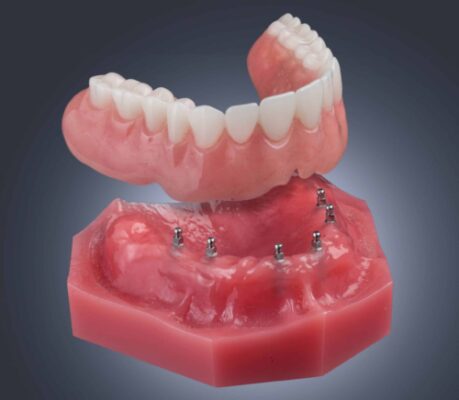
But that’s not the end of the story. There’s another full-arch tooth replacement option that can slow bone loss while improving how your denture functions day to day. By securing a denture with dental implants, including mini dental implants, we create a more stable foundation and stimulate the jawbone.
Stabilizing Dentures With Mini Dental Implants
Mini dental implants are small titanium posts that we place directly into your jawbone to support your denture.
Because the implant connects directly to the bone, your denture stays in place during everyday use. At the same time, the implant serves as a tooth root, helping stimulate your jawbone and reduce ongoing bone loss.
We often recommend mini dental implants because the placement process is more straightforward and less invasive than traditional implant methods. We create a small pilot opening in the gum and guide the implant into position without large incisions or stitches. As a result of the minimally invasive process, recovery tends to be more manageable. Most patients notice that the initial soreness improves within a few days.
This shorter healing period supports a more efficient recovery. Strong stability from the outset also makes mini dental implants a practical option for keeping your denture more secure and better supported during daily use.
Explore Your Denture Options in Dunn, NC, Today!
Full dentures restore structure and function, but the type you choose shapes how they perform over time. A denture that rests on the gums relies on the shape of your jaw, so changes over time can affect how it fits and functions.
Dental implant options provide a more stable foundation that helps maintain that structure.
If you are considering full dentures and want to understand which approach makes the most sense for your situation, schedule a free implant consultation.