
When people search for a dental plate, they are often surprised to learn they have more options than they expected. Many use the term “dental plate” to describe any type of denture, but modern tooth replacement includes a wide range of denture solutions that differ in how they fit, how they function, and how they are supported.
For many people, the word “denture” still suggests a single appliance. In reality, today’s dentures come in several forms. Some rest on the gums and can be removed each day. Others attach to dental implants for greater stability, and some remain fixed in place. Each option serves a different purpose and works best for different oral health needs.
Finding the right denture is less about choosing a product and more about understanding how you want your teeth to function, what level of stability you want, and what your mouth can support. Those answers help shape a treatment plan that fits your needs, not just the name you searched online.
Your Dental Plate Options in Dunn, NC
Traditional Dentures
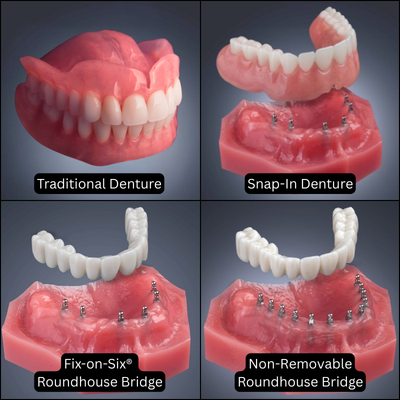
Traditional full dentures (or traditional dental plate) sit directly on top of the gums and rest along the curve of the jaw. The base is made from a firm acrylic that resembles natural gum tissue, and a whole row of artificial teeth is attached to that base. Once placed, the denture relies on close contact with the gums to stay in position.
The shape of the denture follows the contours of the mouth so it rests snugly against the tissue. A thin layer of saliva creates surface tension between the denture and the gums, which helps hold it in place, particularly for an upper denture that covers the roof of the mouth.
Over time, the muscles of the lips, cheeks, and tongue adapt to help steady the denture during speaking and eating. When the fit loosens or extra hold is needed, many people turn to denture adhesive to improve grip.
Snap-In Dentures
Snap-in dentures build on that foundation by adding another source of support. The denture remains removable, but instead of depending only on the gums, it connects to dental implants that we place into the jawbone. Those implants function as anchors.
On the underside of the denture, small housings hold flexible O-rings. Each O-ring lines up with an implant post that extends slightly above the gumline. When you press the dentures into place, the O-rings stretch gently over the posts and lock around them. The connection works much like a button fastening through a buttonhole. Two separate parts meet, engage, and hold together until you intentionally pull them apart. That snapping action creates a secure fit without adhesive while still allowing the denture to be removed for cleaning.
Is a Roundhouse Bridge the Same as a Dental Plate?
A roundhouse bridge replaces a full arch of missing teeth, much like a dental plate. However, a roundhouse bridge does not rest on the gums or snap in and out; it spans the entire curve of the jaw as a single continuous structure.
The bridge resembles a connected row of crowns arranged in a wide U or horseshoe shape that follows the natural outline of your upper or lower jaw. That shape allows the bridge to replace every missing tooth evenly while leaving the tongue room to move naturally on the lower arch and keeping the roof of the mouth uncovered on the upper arch. What you see is simply a clean arch of teeth, not a gum-colored base. The result looks and feels more like teeth have always been there.
Like snap-in dentures, roundhouse bridges attach to dental implants or mini implants placed in the jawbone, allowing them to remain in place full-time. From there, the design moves in two directions: semi-removable and non-removable.
With a semi-removable roundhouse bridge, you never take the bridge out yourself. Every six months or so, you return to our office, where we remove the bridge, clean it thoroughly, and check the implants underneath.
A non-removable roundhouse bridge remains permanently secured to the implants. Once we cement it in place, it does not come out. Daily care follows a routine similar to caring for natural teeth, with brushing and ongoing maintenance built into your normal hygiene habits.
Explore Your Dental Plate Options With Us
A dental plate can mean different things to different people. For some, it is a traditional removable denture. For others, it may be a snap-in denture or an implant-supported bridge. The right solution depends on your oral health, the amount of support your jaw can provide, and how you want your teeth to function every day.
If you are ready to replace missing teeth, we can help you compare your options and explain what each one offers. Together, we will determine which approach fits your goals and create a treatment plan built around your needs. Contact J. Michael Williams, DDS, to schedule your free consultation.