
All-on-4 is a full-arch dental implant treatment that uses four strategically placed implants to support a complete set of replacement teeth. The result is a fixed, non-removable restoration that can give patients secure support without relying on the gums like a traditional denture. For many people, that concept is genuinely valuable. It uses implants as a foundation for a stronger, steadier full-arch replacement. However, some patients run into roadblocks when they begin exploring treatment. All-on-4 relies primarily on traditional dental implants, which are wider in diameter and typically require enough bone volume to support them. Patients with bone loss, concerns about grafting, or hesitation around a more involved surgical process may start asking an important question: are there All-on-4 alternatives that still provide secure full-arch tooth replacement? Fortunately, yes.
While All-on-4 remains an effective option for many patients, alternative implant systems like Fix-on-Six® can make stable, full-arch restoration a realistic possibility for those seeking a different path.
All-on-4 Alternatives: What Are Your Options?
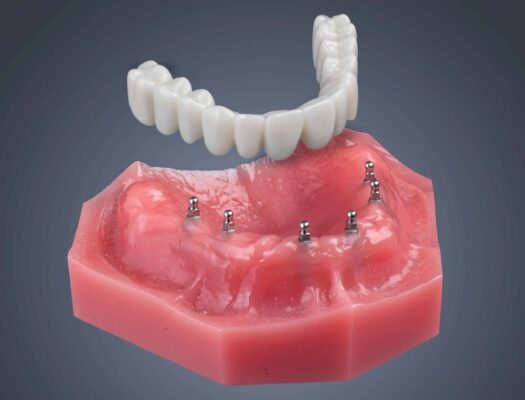
Fix-on-Six® follows a similar full-arch concept to All-on-4®. Like All-on-4, it uses a roundhouse bridge to replace a complete row of teeth in the upper or lower jaw. However, Fix-on-Six relies on 6 to 10 mini dental implants that we place in the jawbone. These implants create a stable foundation for the bridge. They help the restoration feel secure without relying on the gums for support.
However, mini implants are less than 3 millimeters in diameter, which is roughly half the size of a traditional dental implant. Traditional implants often require flap surgery, which means the gum tissue is cut and lifted back so the dentist can see the bone, place the implant, and suture the tissue closed again. That process creates a larger surgical area and requires healing across both the soft tissue and bone.
To place a mini dental implant, we create a small pilot hole through the gum tissue and into the bone. The implant is then inserted through that small opening. The gum tissue does not need to be cut and lifted back the same way. As a result, the procedure usually causes less tissue disruption. A smaller opening also helps preserve more of the surrounding blood supply. This process may lead to less swelling, reduced postoperative discomfort, and a shorter recovery period.
Why Choose a System With More Dental Implants?
At first, the difference between 4 implants and 6 to 10 implants may seem easy to judge. Fewer implants can sound appealing, especially when you are comparing full-arch options and trying to understand what treatment may involve. We look at implant number a little differently. The goal is not to use extra implants simply for the sake of using them. The goal is to create broad, balanced support for a full arch of replacement teeth.
A roundhouse bridge must handle pressure from chewing across the entire upper or lower jaw. When we place additional mini dental implants throughout the arch, those implants help distribute biting forces across more support points. Think of it like holding up a long shelf. A shelf supported by several brackets can distribute weight more evenly than one supported by fewer points. In the mouth, that added support can help the bridge feel secure while reducing the amount of force placed on any single implant.
Additional implants can also be helpful in the uncommon event that an implant fails. Dental implant failure can occur, although it is rare. Removing a loose single implant is fairly straightforward. Managing a failing implant beneath a fixed bridge is more delicate. It is more like removing one support post from under a shelf without damaging the shelf or the wall around it.
With an All-on-4 system, losing one implant leaves only three implants to support the full bridge. With Fix-on-Six, the bridge starts with more support points across the jaw. In that sense, the extra implants can serve a little like a spare tire. You hope you never need that backup support, but having it can make the overall plan feel more secure.
Consider All-on-4 Alternatives in Dunn, NC
All-on-4 remains a valuable option for many patients, but it is not the only way to restore a full arch of teeth. For patients with bone loss or hesitation around a more involved surgical process, Fix-on-Six may make secure full-arch tooth replacement feel more realistic.
When you visit for a consultation, we can evaluate your jawbone, discuss your goals, and explain how different full-arch implant options compare. Some patients may still be strong candidates for All-on-4, while others may benefit from alternatives with mini dental implants.
Schedule a free implant consultation today to find out which option is right for you!